Anthropic AI: Leading the Future of Safe AI Systems
By Andrew Pyle

The landscape of artificial intelligence development has shifted dramatically over the past few years, with safety and responsible deployment becoming as critical as raw performance. At the forefront of this movement stands Anthropic, a company that has redefined how organizations approach AI implementation. Understanding anthropicai and its flagship product Claude is essential for professionals and businesses seeking to adopt AI systems that prioritize both capability and trustworthiness. This exploration examines why Anthropic's approach matters and how it influences the broader AI ecosystem.
The Foundation of Anthropic's AI Philosophy
Anthropic was founded in 2021 by former OpenAI researchers who believed the AI industry needed a stronger focus on safety and interpretability. The company's mission centers on building reliable, interpretable, and steerable AI systems that organizations can deploy with confidence.
The company has positioned itself uniquely in the competitive AI landscape. Unlike competitors focused primarily on performance metrics, Anthropic distinguishes itself embed safety constraints directly into model training. This approach ensures that AI systems align with human values from the ground up rather than requiring post-hoc corrections.
Constitutional AI: A New Training Paradigm
Constitutional AI represents Anthropic's core innovation in model development. This methodology trains models to be helpful, harmless, and honest by incorporating explicit principles during the training process.
Key principles include:
- Transparency: Models explain their reasoning processes clearly
- Harmlessness: Systems avoid generating dangerous or manipulative content
- Accuracy: Responses prioritize factual correctness over engagement
- Respect: AI maintains appropriate boundaries in all interactions
The constitutional approach differs fundamentally from traditional reinforcement learning methods. Instead of simply optimizing for user engagement or satisfaction scores, anthropicai systems evaluate outputs against a comprehensive set of ethical guidelines. This creates AI that businesses can trust in sensitive applications.

Claude AI: Anthropic's Enterprise Solution
Claude represents Anthropic's primary product offering, available in multiple versions optimized for different use cases. IBM's analysis of Claude AI, content generation, and safe information handling.
The Claude family includes several models designed for specific enterprise needs:
| Model Version | Context Window | Primary Use Case | Key Strength |
|---|---|---|---|
| Claude Opus | 200,000 tokens | Complex analysis | Deep reasoning capabilities |
| Claude Sonnet | 200,000 tokens | Balanced performance | Speed and accuracy balance |
| Claude Haiku | 200,000 tokens | High-volume tasks | Rapid response generation |
Real-World Applications Across Industries
Organizations deploy anthropicai technology across diverse sectors. Financial services firms use Claude for regulatory compliance review, analyzing contracts and policy documents against evolving legal standards. Healthcare providers leverage the models for medical literature synthesis while maintaining strict privacy controls.
The California government recently partnered with Anthropic to integrate Claude into public servicesassistance while ensuring sensitive citizen data remains protected.
Professional development platforms benefit significantly from Anthropic's capabilities. Understanding modern AI applicationsoncepts clearly, exactly what Claude excels at providing.
Security and Privacy in Anthropic AI Systems
Security concerns remain paramount as organizations integrate AI into critical workflows. Recent research has examined potential vulnerabilities in large language modelsinadvertently reveal sensitive training data.
Anthropic addresses these concerns through multiple protective layers:
Data protection mechanisms:
- Training data filtering to exclude personal information
- Output monitoring for potential sensitive data leakage
- Encryption of data in transit and at rest
- Regular security audits by independent firms
Access control features:
- Role-based permissions for organizational deployments
- Audit logging of all interactions
- Configurable content filters for specific use cases
- Integration with existing identity management systems
The company's Model Context Protocol (MCP) has received particular attention. Academic research on MCP securitynding against potential threats in AI agent systems. This ongoing collaboration between industry and academia strengthens the anthropicai ecosystem.
Interpretability as a Security Feature
Anthropic prioritizes model interpretability, viewing it as essential to security rather than a mere convenience. When AI systems can explain their reasoning, security teams can audit decisions and identify potential issues before they escalate.
This transparency proves especially valuable in regulated industries. Financial institutions using Claude can demonstrate to auditors how AI-generated recommendations derive from specific data points and reasoning chains. Healthcare providers can verify that diagnostic assistance tools consider appropriate medical literature.
Practical Implementation for Business Teams
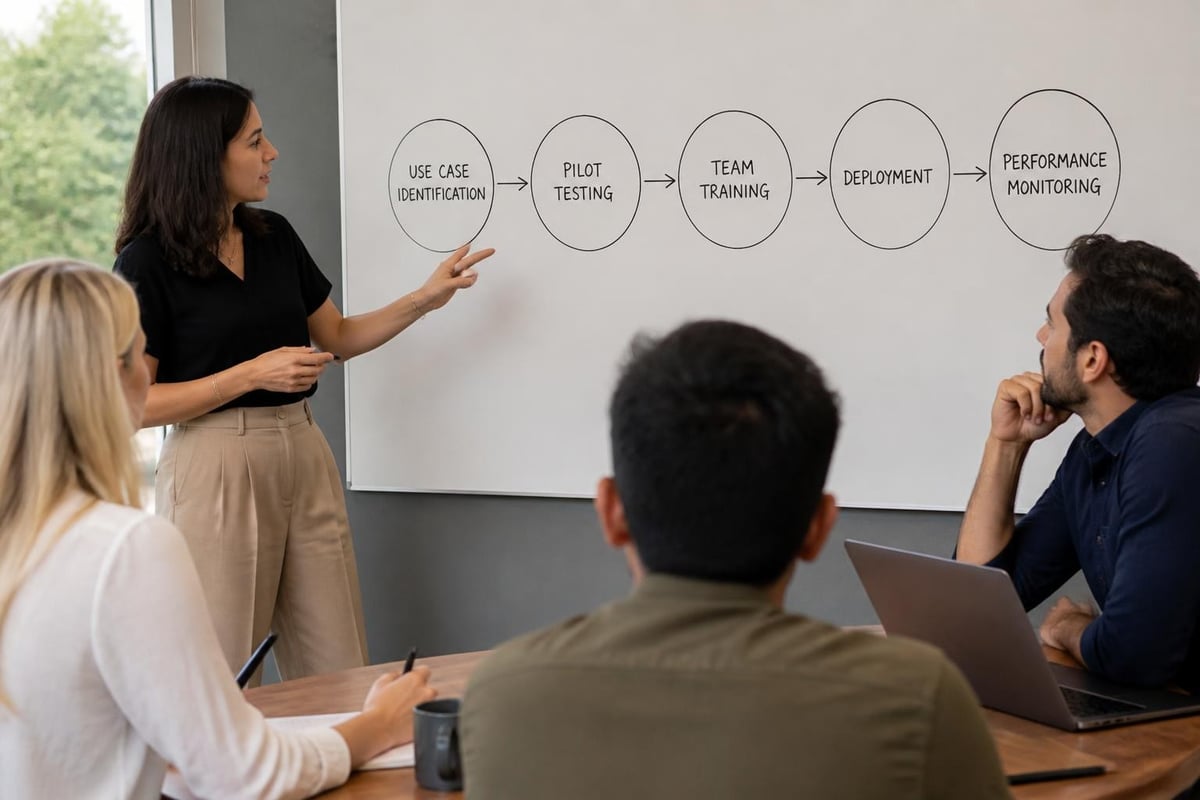
Organizations considering anthropicai deployment face important strategic decisions. Successful implementation requires more than technical integration; it demands careful planning around use cases, training, and ongoing governance.
Identifying High-Value Use Cases
Businesses should start by identifying processes where Claude's strengths align with operational needs. Document-heavy workflows represent ideal starting points:
- Contract review and analysis: Extract key terms, identify potential risks, flag inconsistencies
- Customer support escalation: Handle complex inquiries requiring nuanced understanding
- Research synthesis: Compile insights from multiple sources into actionable summaries
- Content creation: Generate first drafts of reports, emails, and documentation
- Code review assistance: Explain code functionality, suggest improvements, identify bugs
Teams exploring AI applicationsbility, success metrics, and organizational readiness. Not every process benefits equally from AI enhancement.
Training and Adoption Strategies
Technology deployment succeeds or fails based on user adoption. Even the most sophisticated anthropicai implementation delivers limited value if employees cannot use it effectively.
Effective training programs include:
- Hands-on workshops: Interactive sessions where teams practice with real scenarios
- Use case libraries: Documented examples showing successful applications
- Prompt engineering guidance: Teaching users how to frame requests effectively
- Feedback mechanisms: Channels for users to report issues and suggest improvements
Organizations should designate AI champions within departments who become expert users and help colleagues navigate challenges. This distributed support model scales better than centralized help desks.
Learning platforms like Andrew J. Pyles to understanding AI fundamentals, ensuring teams grasp underlying concepts rather than just memorizing procedures. This deeper knowledge enables more creative and effective AI utilization.
Comparing Anthropic to Alternative AI Platforms
The AI market offers numerous options, each with distinct strengths. Understanding how anthropicai compares helps organizations make informed decisions.
| Feature | Anthropic Claude | GPT-4 | Gemini Pro |
|---|---|---|---|
| Context window | 200,000 tokens | 128,000 tokens | 128,000 tokens |
| Safety focus | Constitutional AI | RLHF | Harm reduction |
| API availability | Yes | Yes | Yes |
| Enterprise support | Comprehensive | Varies by tier | Google Cloud integration |
| Interpretability | High priority | Moderate | Moderate |
YouTube Video
Cost Considerations and ROI
Pricing models vary significantly across AI platforms. Anthropic structures Claude pricing based on token usage, with different rates for input and output tokens across model tiers. Organizations should calculate expected monthly usage before committing.
ROI calculations should account for both direct cost savings and qualitative benefits. A customer service team using anthropicai might reduce response times by 40% while improving satisfaction scores. These combined impacts often justify premium pricing over commodity alternatives.
The Broader Impact of Anthropic's Approach
Anthropic's influence extends beyond its direct product offerings. The company's research and public advocacy have shaped industry conversations about responsible AI development.
Industry contributions include:
- Publishing research on AI safety methodologies
- Participating in policy discussions about AI regulation
- Sharing best practices for model evaluation
- Contributing to open standards for AI interpretability
This thought leadership benefits the entire AI ecosystem. Even organizations not using Claude directly benefit from improved safety standards that Anthropic's work has encouraged across competitors. The rising tide of responsible AI development lifts all boats.

Emerging Capabilities and Future Developments
The anthropicai platform continues evolving rapidly. Recent announcements have expanded Claude's multimodal capabilities, allowing processing of images alongside text. This opens new application categories.
Multimodal Analysis Applications
Visual document processing represents a transformative capability. Organizations can now submit scanned contracts, architectural drawings, medical imaging, or product photos for AI analysis. Claude extracts relevant information, identifies anomalies, and answers questions about visual content.
This advancement eliminates previous workflow bottlenecks where teams manually described images before AI could assist. Direct visual analysis accelerates processes across industries from construction project management to medical diagnosis support.
Professionals exploring AI developmentas they significantly expand potential applications beyond pure text processing.
Integration and API Ecosystem
Anthropic provides robust APIs that enable seamless integration with existing business systems. The platform supports standard protocols and offers comprehensive documentation for developers.
Integration patterns include:
- Direct API calls: Custom applications making requests to Claude endpoints
- Workflow automation: Integration with tools like Zapier or Make
- Embedded chat interfaces: Adding Claude-powered assistance to internal applications
- Batch processing: Bulk analysis of documents or data sets
The Model Context Protocol (MCP) framework allows developers to extend Claude's capabilities by connecting it to external data sources and tools. This extensibility ensures anthropicai systems can access current information and perform actions beyond text generation.
Development teams should review synthetic datasetlized applications, ensuring quality inputs that maximize Claude's effectiveness in domain-specific contexts.
Ethical Considerations and Governance
Deploying AI responsibly requires ongoing attention to ethical implications. Anthropic provides tools and frameworks, but organizations must establish appropriate governance structures.
Key governance components:
- Usage policies: Clear guidelines defining acceptable AI applications
- Review processes: Human oversight for high-stakes decisions
- Bias monitoring: Regular evaluation of outputs for potential bias
- Privacy protection: Ensuring AI systems handle data appropriately
- Incident response: Procedures for addressing problematic outputs
Cross-functional governance committees typically include representatives from legal, compliance, IT security, and business units. This diverse perspective helps identify potential issues before they impact operations.
Organizations should document their AI governance frameworks and review them regularly as technology and regulations evolve. The Forbes profile of Anthropiclicymakers, signaling that regulatory frameworks will continue developing.
Performance Optimization for Enterprise Deployments
Maximizing value from anthropicai requires ongoing optimization. Organizations should establish metrics, monitor performance, and iterate on implementation approaches.
Measuring Success
Different use cases demand different success metrics. Customer service applications might track response time reduction and satisfaction scores. Content creation workflows could measure output quality and revision requirements. Research applications often focus on comprehensiveness and accuracy.
Common KPIs include:
- Task completion time reduction
- Error rate decrease
- User satisfaction scores
- Cost per transaction
- Adoption rate among intended users
Teams should establish baseline measurements before deployment and track improvements over time. This data-driven approach identifies which applications deliver genuine value versus those requiring adjustment.
Building Internal AI Expertise
Long-term success with anthropicai technology requires developing organizational capabilities. External consultants can assist initial implementation, but sustained value comes from internal expertise.
Progressive organizations create AI centers of excellence that combine technical skills with domain knowledge. These teams develop best practices, support business units, and stay current with platform updates.
Training investments should span multiple skill levels. Executive education ensures leadership understands AI capabilities and limitations. Technical training prepares developers to build effective integrations. End-user training helps employees leverage AI in daily work.
Resources like best AI tools for businessmed decisions about which technologies complement their anthropicai deployment.
Anthropic's commitment to safe, interpretable AI systems has established new standards for enterprise AI deployment. Organizations seeking to harness artificial intelligence responsibly find Claude's constitutional approach aligns with governance requirements while delivering powerful capabilities. The platform's extensive context windows, multimodal processing, and robust security features make it suitable for demanding business applications across industries. As AI continues transforming how businesses operate, understanding and effectively implementing systems like those from Anthropic becomes essential for competitive advantage. Whether you're exploring AI for the first time or enhancing existing implementations, Andrew J. Pyletions, hands-on examples, and actionable insights you need to successfully adopt and apply these transformative technologies in your organization.