AI Orchestration: Coordinating Intelligence at Scale
By Andrew Pyle

As artificial intelligence systems become more sophisticated and specialized, organizations face a growing challenge: how to coordinate multiple AI models, data sources, and workflows into cohesive solutions that deliver real business value. AI orchestration has emerged as the critical framework that enables businesses to manage this complexity, ensuring that different AI components work together seamlessly rather than operating in isolation. This capability transforms fragmented AI implementations into integrated systems that can tackle complex, multi-step challenges across entire organizations.
Understanding AI Orchestration Fundamentals
AI orchestration represents the systematic coordination of multiple AI models, systems, and processes to achieve specific business outcomes. Rather than deploying standalone AI solutions that operate independently, orchestration creates a unified layer that manages how different AI components interact, share data, and contribute to overall objectives.
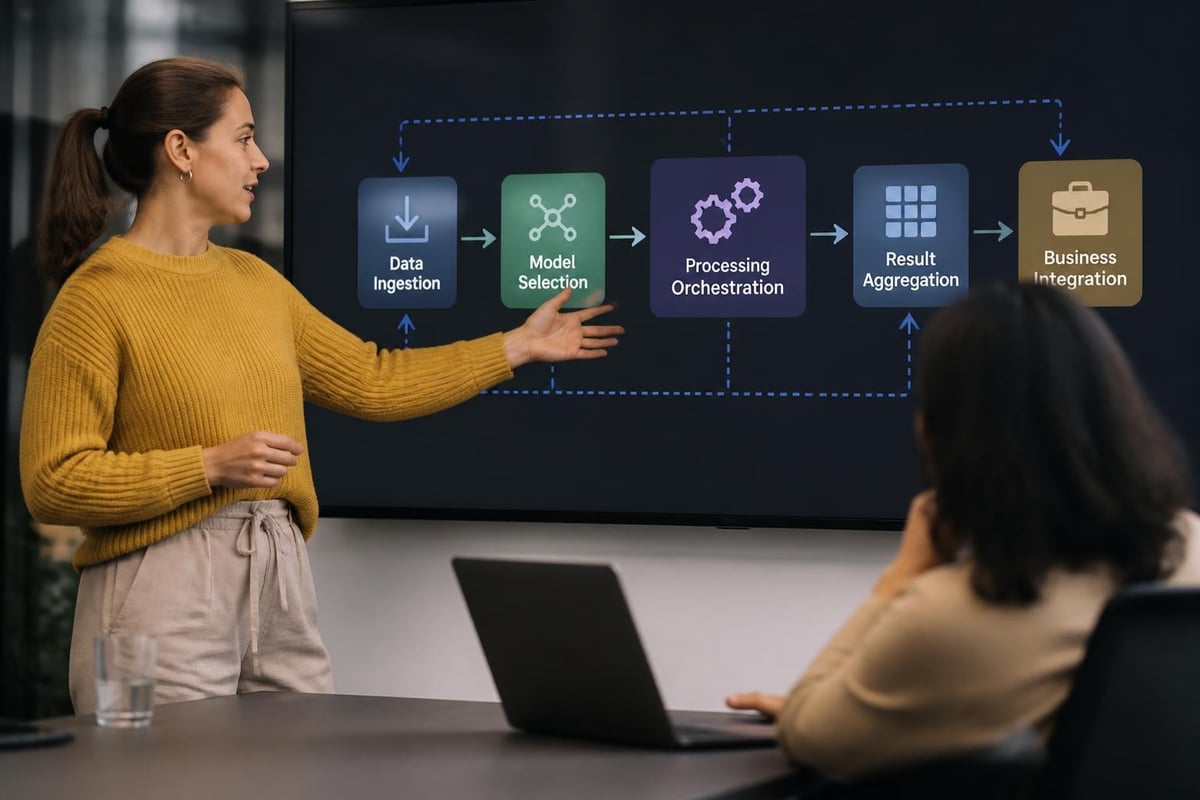
The foundation of ai orchestration rests on several key components that work in concert. These include model management systems that track and version different AI models, data pipeline orchestrators that ensure information flows correctly between systems, and workflow engines that define how tasks progress through various AI processing stages.
Core Components of Orchestration Systems
Modern orchestration frameworks incorporate multiple technical elements that enable smooth operation:
- Model registry and versioning to track which AI models are available and which versions are currently deployed
- Data flow management to ensure information moves efficiently between different AI systems
- Task scheduling and routing to direct work to the appropriate AI models based on requirements
- Monitoring and observability to track performance and identify issues across the entire AI ecosystem
- Integration adapters that connect AI systems with existing business applications and data sources
These components work together to create what IBM describes as a comprehensive approacht through ongoing optimization and eventual retirement of outdated models.
Why Organizations Need AI Orchestration
The complexity of modern AI implementations creates significant challenges for businesses attempting to scale their artificial intelligence capabilities. Without proper orchestration, organizations encounter numerous obstacles that limit the effectiveness of their AI investments.
Solving the Integration Challenge
Many businesses discover that their AI initiatives create isolated pockets of intelligence rather than cohesive systems. Marketing might deploy one chatbot, customer service another, and operations a third predictive model, with no coordination between them. AI orchestration addresses this fragmentation by providing a central coordination layer.
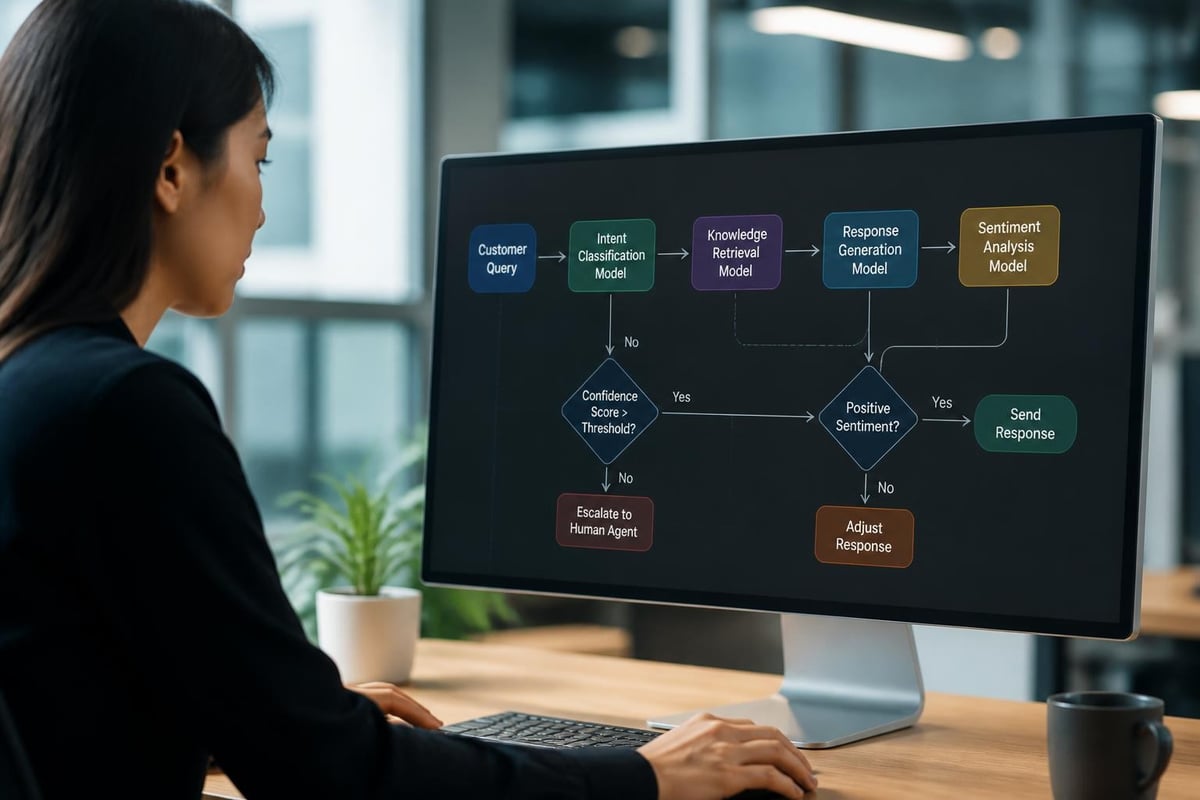
Consider a customer service scenario where understanding customer intent requires multiple specialized models. One model might handle natural language processing, another sentiment analysis, a third knowledge base retrieval, and a fourth response generation. Without orchestration, connecting these models requires custom integration code for each interaction. With orchestration, a single workflow defines how these models collaborate, dramatically reducing complexity.
| Challenge | Without Orchestration | With Orchestration |
|---|---|---|
| Model Integration | Custom code for each connection | Standardized workflow definitions |
| Data Consistency | Manual synchronization required | Automated data pipeline management |
| Performance Monitoring | Separate dashboards per model | Unified observability across all systems |
| Scaling Operations | Individual model scaling decisions | Coordinated resource allocation |
| Error Handling | Model-specific error management | Centralized exception handling and recovery |
Implementing Effective Orchestration Strategies
Successful ai orchestration requires thoughtful planning and implementation that aligns with business objectives. Organizations must consider both technical architecture and operational processes when building their orchestration capabilities.
Choosing the Right Orchestration Approach
Different business contexts demand different orchestration strategies. Some organizations benefit from centralized orchestration platforms that manage all AI workloads from a single control plane. Others require distributed orchestration that allows individual business units to maintain autonomy while ensuring overall coordination.
Centralized orchestration works well for organizations with:
- Standardized AI infrastructure across departments
- Strong central governance requirements
- Shared data resources and common business processes
- Limited technical resources that benefit from consolidation
Distributed orchestration suits organizations that have:
- Diverse technical environments across business units
- Domain-specific AI requirements that resist standardization
- Regulatory constraints requiring data isolation
- Mature technical teams capable of managing local orchestration
The choice between these approaches significantly impacts how teams design their systems and allocate resources. Understanding how AI orchestration works
Building Orchestration Workflows
Effective workflows form the backbone of any orchestration system. These workflows define how data moves through different AI models, what conditions trigger specific actions, and how results are aggregated and delivered to end users or downstream systems.
A typical workflow might include these sequential steps:
- Input validation that ensures incoming data meets quality standards before processing
- Model selection that routes requests to appropriate AI models based on content and context
- Parallel processing where multiple models analyze the same input simultaneously
- Result aggregation that combines outputs from different models into coherent responses
- Post-processing that formats results for specific delivery channels or applications
- Feedback collection that captures performance data for continuous improvement
Each step requires careful configuration to balance performance, accuracy, and resource consumption. Organizations often discover that initial workflow designs need refinement as they observe real-world performance and user feedback.
Operational Benefits and Business Impact
The implementation of ai orchestration delivers tangible benefits that extend beyond technical improvements to drive meaningful business outcomes. Organizations that successfully orchestrate their AI systems report significant advantages across multiple dimensions.
Efficiency and Resource Optimization
Orchestration enables more efficient use of computational resources by intelligently routing workloads and managing model execution. Rather than running all models continuously, orchestration systems can activate specific models only when needed, reducing infrastructure costs while maintaining responsiveness.
This efficiency extends to human resources as well. Data scientists and engineers spend less time on integration plumbing and more time improving model accuracy and developing new capabilities. Enhanced customer experiences and reduced employee effortations implementing orchestration frameworks.
Improved Consistency and Reliability
When AI systems operate independently, inconsistencies inevitably emerge. One model might classify a customer as high-priority while another treats them as standard tier. Orchestration ensures that all AI components access the same underlying data and follow consistent business rules, eliminating these discrepancies.
Error handling becomes more robust under orchestration as well. If one model in a workflow fails, the orchestration system can automatically retry, route to backup models, or gracefully degrade service rather than producing complete failures. This resilience proves crucial for customer-facing applications where reliability directly impacts satisfaction and retention.
Advanced Orchestration Patterns and Techniques
As organizations mature in their orchestration capabilities, they often adopt more sophisticated patterns that enable complex AI-driven processes. These advanced techniques represent the frontier of practical AI implementation in enterprise environments.
Agentic AI and Autonomous Orchestration
Traditional orchestration follows predefined workflows where human designers specify exactly how AI models should interact. Emerging agentic AI approaches allow AI systems themselves to participate in orchestration decisions, dynamically determining which models to invoke and how to combine their outputs based on context and goals.
This shift toward autonomous orchestration requires robust governance frameworks to ensure AI agents operate within acceptable boundaries. Organizations must define clear constraints, monitoring systems, and override mechanisms while allowing enough flexibility for agents to optimize their approaches based on real-world performance data.
The concept of AI factories as unified architecturesd infrastructure supports diverse AI workloads while maintaining operational coherence.
Context-Aware Model Selection
Advanced orchestration systems incorporate sophisticated logic for selecting which AI models to use for specific tasks. Rather than static routing rules, these systems consider multiple factors:
- Historical performance data showing which models excel at specific subtasks
- Current system load to balance workload across available resources
- Data characteristics that might favor certain model architectures
- Business context such as customer tier or transaction value
- Compliance requirements that restrict which models can process certain data types
This dynamic model selection optimizes outcomes while managing costs and ensuring regulatory compliance. The orchestration layer continuously learns from results to improve future routing decisions, creating a self-improving system that becomes more effective over time.
Governance and Risk Management in Orchestration
Implementing ai orchestration at scale introduces important governance considerations that organizations must address to ensure responsible AI deployment. The coordination layer itself becomes a critical control point for managing AI-related risks.
Ensuring Transparency and Auditability
Orchestration systems create natural opportunities for implementing comprehensive logging and audit trails. Every interaction between AI models, every decision about routing or model selection, and every data transformation can be recorded for later analysis.
| Governance Capability | Implementation Through Orchestration | Business Value |
|---|---|---|
| Model Provenance Tracking | Automated logging of which models processed each request | Enables debugging and accountability |
| Data Lineage Mapping | Documentation of data flow through multiple AI systems | Supports compliance audits and impact analysis |
| Decision Explainability | Capture of intermediate results and routing logic | Improves trust and facilitates human review |
| Performance Monitoring | Centralized metrics collection across all orchestrated models | Identifies degradation before user impact |
| Access Control | Unified authentication and authorization layer | Simplifies security management |
These capabilities prove essential for regulated industries where organizations must demonstrate responsible AI use. Understanding synthetic datasetrtant in orchestrated environments where training data quality affects multiple downstream models.
Managing Model Drift and Performance Degradation
AI models naturally degrade over time as real-world conditions diverge from training data distributions. Orchestration systems can detect this drift by monitoring prediction confidence, error rates, and user feedback across the entire workflow.
When degradation is detected, orchestration enables several response strategies:
- Automatic failover to backup models with better current performance
- Graduated rollout of retrained models to validate improvements before full deployment
- A/B testing between model versions to quantify performance differences
- Human escalation for cases where no available model meets quality thresholds
Real-World Applications Across Industries
The practical applications of ai orchestration span virtually every industry, with implementations tailored to specific business contexts and challenges. Examining concrete examples helps illuminate how orchestration delivers value in practice.
Customer Service and Support
Modern customer service platforms orchestrate multiple AI systems to deliver seamless experiences. When a customer contacts support, orchestration coordinates natural language understanding, customer history retrieval, sentiment analysis, and knowledge base search to provide agents with comprehensive context.
Conversational AI use caseshere different models handle intent recognition, entity extraction, and response generation in coordinated fashion. The orchestration layer ensures these components work together smoothly rather than creating disjointed experiences.
Financial Services Risk Management
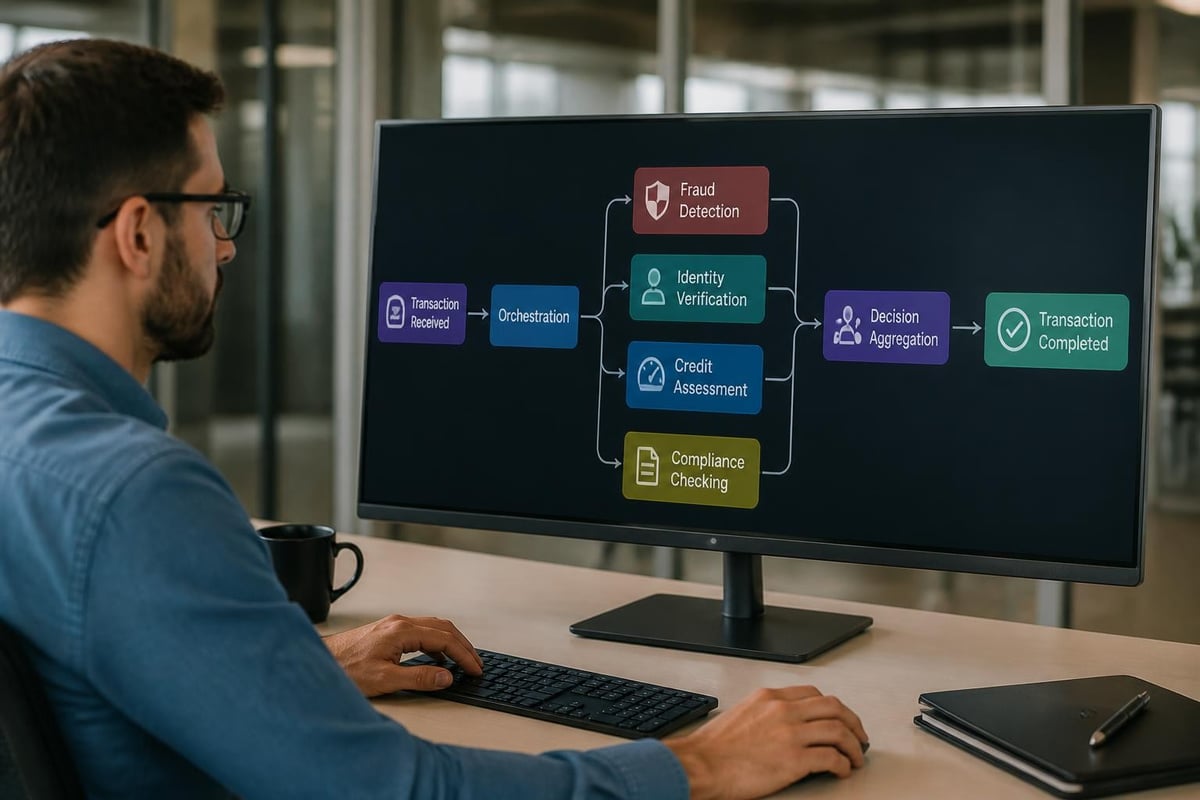
Banks and financial institutions use ai orchestration to coordinate multiple fraud detection, credit risk, and compliance models. A single transaction might be evaluated by models checking for unusual patterns, verifying identity, assessing creditworthiness, and ensuring regulatory compliance.
The orchestration system manages the sequence and timing of these evaluations, determining which checks can run in parallel versus which require results from previous steps. It also handles the complex logic of combining multiple risk scores into final decisions while maintaining audit trails for regulatory review.
Healthcare Diagnostic Support
Healthcare providers orchestrate AI models for medical imaging analysis, patient risk stratification, and treatment recommendation. A diagnostic workflow might combine image analysis models identifying potential abnormalities, natural language processing extracting relevant information from medical records, and clinical decision support systems suggesting appropriate next steps.
Orchestration ensures these diverse models integrate smoothly while maintaining strict privacy controls and audit requirements. The system can route sensitive data only to approved models and maintain detailed records of which AI systems contributed to clinical decisions.
Technical Architecture Considerations
Building robust ai orchestration infrastructure requires careful attention to architectural patterns that support scalability, reliability, and maintainability. Organizations must make informed choices about technology stacks and deployment models.
Platform Selection and Integration
Organizations face several options for implementing orchestration capabilities:
Cloud-native orchestration platforms provide fully managed services with built-in scaling, monitoring, and integration with other cloud AI services. These platforms reduce operational overhead but may limit customization and create vendor dependencies.
Open-source orchestration frameworks offer maximum flexibility and control, allowing organizations to tailor systems to specific requirements. However, they require more technical expertise to implement and maintain.
Hybrid approaches combine managed services for commodity orchestration functions with custom components for specialized needs. This balanced strategy often provides the best combination of efficiency and flexibility for large enterprises.
The importance of orchestration as the next frontierbigger obstacles than individual model performance.
Scaling Orchestration Systems
As AI workloads grow, orchestration systems must scale to handle increasing volumes while maintaining performance and reliability. This scaling occurs along multiple dimensions:
- Request throughput requiring orchestration components to process more simultaneous workflows
- Model diversity as organizations deploy more specialized AI models for different tasks
- Workflow complexity with increasingly sophisticated multi-step processes
- Geographic distribution to support global operations with local data residency requirements
Successful scaling strategies typically employ distributed architectures where orchestration functions run close to data sources and users, minimizing latency while maintaining central governance and visibility.
Future Directions in AI Orchestration
The field of ai orchestration continues evolving rapidly as new AI capabilities emerge and organizations gain experience with production deployments. Several trends are shaping the future of how businesses coordinate their AI systems.
Edge and Hybrid Orchestration
As AI processing moves closer to data sources and users, orchestration systems must coordinate workloads across edge devices, local data centers, and cloud environments. This hybrid orchestration introduces new challenges around connectivity, synchronization, and resource management.
Organizations are developing orchestration patterns that can operate effectively even with intermittent connectivity, allowing edge AI systems to function autonomously when necessary while synchronizing with central systems when connections are available.
Multimodal AI Coordination
Emerging AI systems process diverse data types including text, images, audio, and video within single workflows. Orchestration must coordinate specialized models for each modality while ensuring they work together coherently.
A customer service interaction might involve voice recognition, video analysis for visual context, and text processing for transcripts, all coordinated to understand customer needs and deliver appropriate responses. The orchestration layer manages timing, data transformation between modalities, and integration of results from diverse model types.
Continuous Learning and Adaptation
Future orchestration systems will increasingly incorporate feedback loops that enable continuous improvement. Rather than static workflows, these adaptive systems will adjust routing decisions, model selection, and processing strategies based on observed outcomes and changing conditions.
This evolution toward self-optimizing orchestration requires sophisticated monitoring, experimentation frameworks, and safety mechanisms to prevent undesirable adaptations while enabling beneficial improvements.
Building Organizational Capabilities
Technical infrastructure represents only part of successful ai orchestration implementation. Organizations must also develop human capabilities and processes that enable effective use of orchestration frameworks.
Skills and Training Requirements
Teams working with orchestration systems need diverse skills spanning multiple disciplines:
- AI/ML expertise to understand model capabilities and limitations
- Software engineering skills for building and maintaining workflows
- Data engineering capabilities to manage data pipelines feeding orchestrated systems
- Business analysis to translate requirements into orchestration workflows
- Operations expertise for monitoring and maintaining production systems
Organizations should invest in comprehensive training programs that help team members develop these complementary skills. Cross-functional collaboration becomes essential as orchestration inherently bridges multiple technical domains.
Establishing Orchestration Governance
Effective governance frameworks ensure orchestration systems align with business objectives while managing risks appropriately. Key governance elements include:
Workflow approval processes that review new orchestration patterns before production deployment, ensuring they meet technical standards and business requirements.
Performance standards defining acceptable latency, accuracy, and resource consumption for orchestrated workflows, with automated monitoring to detect violations.
Change management procedures governing updates to workflows, model versions, and infrastructure to minimize disruption while enabling continuous improvement.
Incident response protocols specifying how teams should respond when orchestrated systems malfunction, including escalation paths and rollback procedures.
These governance mechanisms create structure without stifling innovation, allowing teams to experiment and iterate while maintaining operational stability and risk management.
AI orchestration has evolved from a specialized technical concern to a fundamental requirement for organizations seeking to deploy AI at scale across their operations. The coordination of multiple AI models, data sources, and business processes through orchestration frameworks enables capabilities that isolated AI systems simply cannot deliver.
Whether you're just beginning to explore AI possibilities or already managing multiple AI implementations, developing orchestration capabilities will prove essential for realizing the full potential of your artificial intelligence investments. Andrew J. Pyletions, practical examples, and actionable guidance you need to understand and implement AI orchestration effectively, helping your organization move from fragmented AI experiments to coordinated intelligence that drives measurable business results.